Decouple data persistence from application side-effects with secure, isolated event propagation.
The Challenge
Executing side-effects (like invalidating a cache or notifying a external service) directly after a database operation often leads to Operational Fragility. In standard implementations: 1. Blocked Transactions: If an event listener is slow or synchronous, it blocks the database session from closing, increasing connection wait times. 2. Failure Leakage: An exception in a "secondary" task (like a failing logging service) can propagate upwards and crash the primary request, even though the database write was successful. 3. Tight Coupling: The database layer becomes aware of high-level application concerns, making the architecture difficult to test or split into microservices later.
The ZCore Elegance
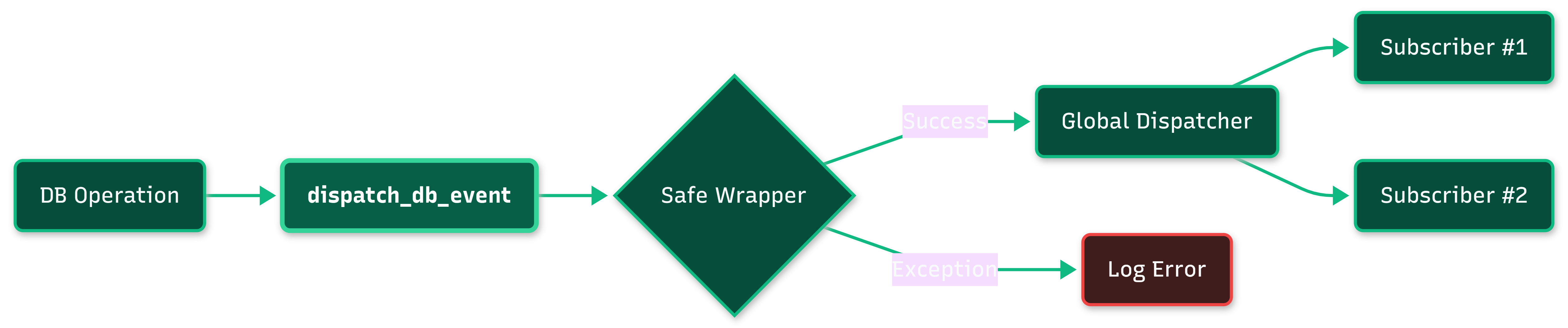
ZCore provides a Global Event Bridge specifically for database lifecycles. By using dispatch_db_event, you ensure that database events are transmitted to the application dispatcher within a secure try/except wrapper. This guarantees that no matter how many listeners fail or crash, the core database logic remains untouched and the primary execution flow continues.
from zcore.db import dispatch_db_event

async def after_record_created(record):
    # Dispatched via secure bridge
    # Handler failures are logged but isolated
    await dispatch_db_event(
        "db.record_created",
        payload={"id": record.id}
    )
# Risks crashing the DB operation if a listener fails
async def after_record_created(record):
    try:
        await dispatcher.dispatch("db.record_created", record.id)
    except Exception as e:
        # You must manually remember to wrap every
        # dispatch call to prevent leakage
        logger.error(f"Listener failed: {e}")
Event Propagation Flow
The DB Event Bridge acts as a non-blocking safety buffer between the low-level data layer and the high-level event subscribers.
Boundaries & Integration
The DB Event system bridges the gap between infrastructure and domain logic without forcing a lock-in.
- Kernel Integration: During the
main.pybootstrap, callingregister_db_event_dispatcher(kernel.dispatcher)links the bridge to the primary application bus [db/events.py]. - Decoupled Payloads: The
payloadargument accepts any Python object or dictionary, allowing you to pass raw database IDs or fully hydrated Pydantic models to your listeners. - Bypass: If you require a "Strict Dispatch" (where the primary operation should fail if a listener fails), you can bypass the bridge and call
kernel.dispatcher.dispatch()directly.
Under-the-Hood Spec
1. The Global Dispatcher Registry
ZCore maintains a private _global_dispatcher reference [db/events.py]. This reference is populated once during application startup via register_db_event_dispatcher. This "Static Registry" pattern ensures that the database layer can access the event bus without requiring complex Dependency Injection (DI) passing through every repository.
2. Async Failure Isolation
The dispatch_db_event function is an asynchronous wrapper [db/events.py]. It wraps the underlying dispatcher call in a comprehensive try/except Exception block. This is critical because it prevents "Greenlet Leakage" where an unhandled exception in an async event handler could otherwise terminate the entire coroutine stack.
3. Structured Diagnostics
When a listener fails, the bridge uses structlog to output a detailed error record [db/events.py]. It captures the event_name and the specific payload that caused the failure, while setting exc_info=True. This allows architects to debug failing side-effects from logs without the users ever seeing an error response.
Event Handlers
Database events are typically used for "Finalized" actions. If you need to trigger logic within a transaction, consider using UnitOfWork.register_event instead, which delays the bridge dispatch until the commit is confirmed.