The unified entry point where infrastructure, security, and domain plugins converge into a running FastAPI instance.
The Challenge
In many FastAPI projects, the main.py file eventually becomes a "God Object"—a massive procedural script that handles logging, database initialization, middleware ordering, exception mapping, and router registration. This leads to:
1. Fragile Middleware Ordering: Placing Authentication after Routing or Session management after Logging, causing cryptic errors.
2. Infrastructure Leaks: Database connection strings and logging configurations mixed with business route definitions.
3. Hard-to-Test Entry Points: Because everything is tightly coupled in one file, spinning up the app for integration tests without the entire stack becomes difficult.
The ZCore Elegance
ZCore provides a declarative bootstrap template. Instead of writing procedural logic, you configure the Kernel, register your domain Plugins, and attach the core middlewares. The main.py serves strictly as an Orchestrator, delegating the heavy lifting to the infrastructure managers and domain plugins.
# Auto-generated via 'zc init'
from fastapi import FastAPI
from zcore import Kernel, settings
from zcore.web import RequestLogMiddleware, ScopedDependencyMiddleware
from zcore.exceptions import app_exception_handler, AppException
from zcore.db import db_manager, register_db_event_dispatcher
from zcore.logging import setup_logging

# 1. Infrastructure Setup
setup_logging()
db_manager.init_app(db_url=settings.DATABASE_URL)

# 2. Kernel & Plugin Registration
kernel = Kernel()
kernel.add_plugin(UsersPlugin()) # Your domain logic
register_db_event_dispatcher(kernel.dispatcher)

# 3. FastAPI Bootstrap
app = FastAPI(title=settings.PROJECT_NAME, lifespan=kernel.lifespan)
kernel.setup(app)

# 4. Middleware & Error Handlers
app.add_middleware(RequestLogMiddleware)
app.add_middleware(ScopedDependencyMiddleware)
app.add_exception_handler(AppException, app_exception_handler)
# Typical 'main.py' in a standard project
app = FastAPI()

@app.on_event("startup")
async def startup():
    # Manual procedural setup
    logging.config.dictConfig(LOG_CONFIG)
    await database.connect()
    # What if this fails? Is the error caught?
    await cache.connect()

# Manual Error Handling for every custom exception
@app.exception_handler(MyCustomError)
async def handler(request, exc):
    return JSONResponse(...)

# Middleware ordering is manual and invisible
app.add_middleware(SessionMiddleware)
app.add_middleware(AuthMiddleware)

app.include_router(users_router)
# File grows to 500+ lines...
Bootstrapping Lifecycle
When you launch your application (via zc run), ZCore executes the following phases in a strict, predictable sequence:
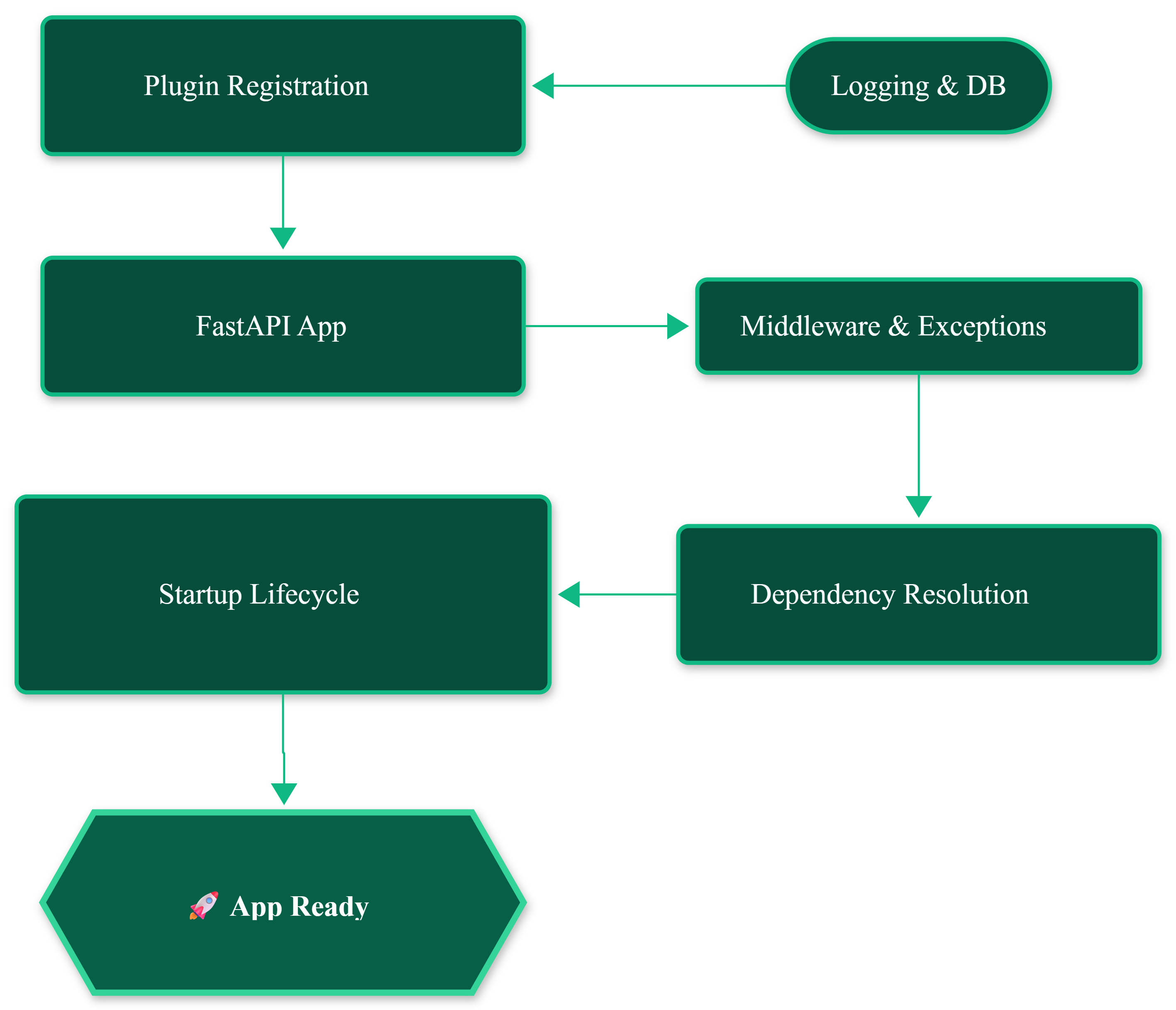
Boundaries & Integration
The ZCore bootstrap process is designed to be a "wrapper" that stays out of your way.
- FastAPI Native: The
appvariable is a standardFastAPI()instance. You can use any native FastAPI feature, such as custom lifespan context managers or third-party middlewares, alongside ZCore. - Infrastructure Isolation: Database and Logging initialization happen before the app starts. This ensures that infrastructure is "warm" before any plugin logic is executed.
- Manual Overrides: If you need to add a router that isn't part of a plugin, you can simply call
app.include_router()inmain.pyas you normally would.
Under-the-Hood Spec
1. Scoped Middleware Dependency
The ScopedDependencyMiddleware is critical. It initializes a unique uuid4 correlation ID for every request and sets up the request-scoped DI container [web/middleware.py]. Most importantly, it injects the active AsyncSession into the container, ensuring that all services and repositories within that request share the same database transaction.
2. Centralized Exception Mapping
The app_exception_handler intercepts any exception inheriting from AppException [exceptions/handlers.py]. It automatically logs the error with structured metadata (request path, method, and correlation ID) and wraps the error message in the standardized ResponseWrapper JSON envelope, ensuring your API never returns a raw traceback.
3. The DB-Event Bridge
By calling register_db_event_dispatcher(kernel.dispatcher), you bridge the database layer with the application event system [db/events.py]. This allows low-level database operations (like a transaction commit) to trigger high-level domain events (like sending a notification) through a loosely coupled, non-blocking bus.
Project Ready
You have now completed the core ZCore Tutorial. Your project is scaffolded, your infrastructure is secure, and your domain logic is structured. Proceed to the How-To Guides to implement advanced features like JWT Auth or Multi-Repository Transactions.