Secure your API with Argon2id hashing, flexible JWT signing, and protocol-based authorization guards.
The Challenge
Implementing security in FastAPI often leads to "Hardcoded Identity" problems. Developers either tightly couple their routes to a specific SQLAlchemy User model or manually parse JWTs in every dependency. Furthermore, many projects still use aging hashing algorithms like BCrypt or, worse, run production environments with default, insecure secret keys found in git history.
The ZCore Elegance
ZCore introduces Protocol-Based Security. Instead of depending on a concrete model, the security layer depends on a UserProtocol. This allows you to use any database (SQL, NoSQL, or External Auth) as long as your user object provides the required attributes. Security is enforced through reusable BasePermission classes that integrate seamlessly with BaseRouter and the kernel's context.
from zcore import BaseRouter, RouteKey
from zcore.security import HasScopes

class DocumentRouter(BaseRouter[DocCreate, DocUpdate]):
    model = Document
    # ... standard config ...

    def get_route_dependencies(self, route_key: RouteKey, action: str):
        # Automated scope checks based on model actions
        # e.g., "documents:delete"
        if route_key == RouteKey.DELETE:
            return [HasScopes("admin", action)]

        return super().get_route_dependencies(route_key, action)
# Manual verification in every route
@router.delete("/{id}")
async def delete_doc(
    id: uuid.UUID,
    user: User = Depends(get_current_user)
):
    # 1. Manual active check
    if not user.is_active: raise AuthError()

    # 2. Manual scope string management
    if "admin" not in user.scopes and "documents:delete" not in user.scopes:
        raise ForbiddenError()

    # 3. Manual service call
    await service.delete(id)
Implementation Guide
1. Define your User Model
Ensure your SQLAlchemy or Pydantic user model implements the UserProtocol.
class User(Base):
    __tablename__ = "users"
    id: Mapped[uuid.UUID] = mapped_column(primary_key=True)
    is_active: Mapped[bool] = mapped_column(default=True)
    is_superuser: Mapped[bool] = mapped_column(default=False)

    @property
    def all_scopes(self) -> set[str]:
        # Return a set of strings representing user permissions
        return {r.name for r in self.roles}
2. Override the Identity Provider
In your main.py, you must tell ZCore how to resolve the current user. ZCore provides a get_current_user_stub that you must override.
from zcore.security import get_current_user_stub, decode_token

async def my_auth_provider(token: str = Depends(oauth2_scheme)) -> User:
    payload = decode_token(token)
    user_id = payload.get("sub")
    # Fetch user from DB
    return await user_service.get(user_id)

# Register the override
app.dependency_overrides[get_current_user_stub] = my_auth_provider
The Auth Lifecycle
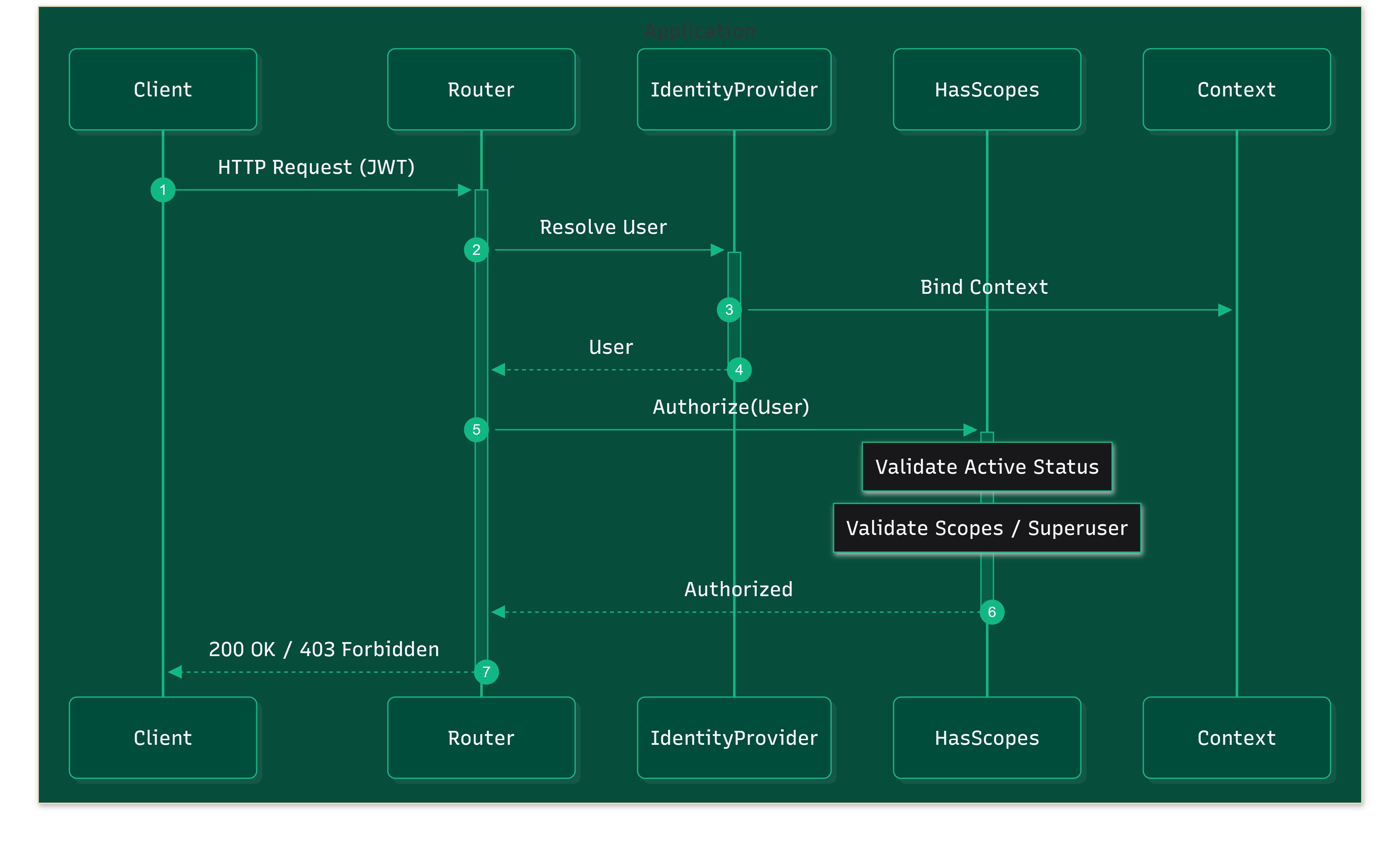
Boundaries & Integration
ZCore provides the cryptographic and logic chassis, while you provide the data.
- OAuth2 Compatible: ZCore's JWT utilities work perfectly with FastAPI's
OAuth2PasswordBearer. - Hashing Freedom: While ZCore provides
get_password_hashusing Argon2id, you can use any library for hashing; ZCore services and repositories accept raw strings. - Bypass Identity: If you have public routes, simply don't add the
HasScopesdependency. Therequest_contextwill remain empty (user_id = None), and ZCore's masking logic will treat the request as unauthenticated.
Under-the-Hood Spec
1. Fatal Security Violation Guard
The jwt.py module contains a hard-coded check [security/jwt.py]. If the ENVIRONMENT is set to production and the SECRET_KEY matches the framework's default fallback string, the application will abort startup with a RuntimeError. This prevents the most common source of production JWT vulnerabilities.
2. Argon2id Hardening
ZCore defaults to Argon2id (the winner of the Password Hashing Competition). The hashing.py module configures high-entropy parameters by default: 64MB memory cost and 3 iterations [security/hashing.py]. These parameters can be tuned via ZCoreCoreSettings to balance security and latency.
3. Protocol-Based "Duck Typing"
The HasScopes permission does not perform an isinstance() check against a database model [security/permissions.py]. Instead, it relies on the UserProtocol interface. This means your "User" could be a database record, a cached Redis object, or even a Mock object during testing, as long as it has id, is_active, and all_scopes.
Security Note
By utilizing the user_context within your identity provider, the authenticated user's ID is available project-wide via get_current_user_id() without passing the user object through every function call.