Securely translate structured JSON filters, complex sorting, and relational eager-loading into optimized SQLAlchemy queries.
The Challenge
Building a truly dynamic search endpoint (e.g., POST /products/search) in standard FastAPI is a security and maintenance nightmare. Developers often face:
1. Manual Filter Mapping: Writing endless if statements for every possible combination of price_gt, category_eq, or name_ilike.
2. Unsafe Joins: Manually managing table joins for relational filters, often leading to duplicate rows or Cartesian products.
3. Recursive DoS: Deeply nested "OR" and "AND" JSON filters that can crash a database if the query complexity isn't limited.
4. Security Leaks: Clients accidentally filtering or sorting by restricted fields (like margin or internal_id) that should be hidden from their role.
The ZCore Elegance
The SearchEngine provides a secure, JSON-driven query builder. It parses a SearchRequest object containing nested filters, sorting rules, and relation-preload paths. It automatically coerces types, validates the request against active context restrictions, and limits the query depth to prevent resource exhaustion.
from zcore.db import SearchRequest, SearchEngine

# 1. Define a structured search payload
request = SearchRequest(
    filters=[
        {"field": "price", "op": "gt", "value": 100},
        {"op": "or", "items": [
            {"field": "category.name", "op": "eq", "value": "Electronics"},
            {"field": "tags", "op": "ilike", "value": "premium"}
        ]}
    ],
    include=["category", "tags"],
    sort=[{"field": "price", "order": "desc"}]
)

# 2. Build and execute securely via Repository
results = await product_repository.search(request)
# Replicating dynamic logic requires hundreds of lines:
@router.get("/search")
async def manual_search(
    price_gt: float = None,
    category: str = None,
    db: AsyncSession = Depends(get_db)
):
    query = select(Product)
    if price_gt:
        query = query.where(Product.price > price_gt)
    if category:
        query = query.join(Category).where(Category.name == category)

    # Manually handling nested OR/AND is almost impossible
    # to write safely and generically for every endpoint.
    result = await db.execute(query)
    return result.scalars().all()
Search Workflow
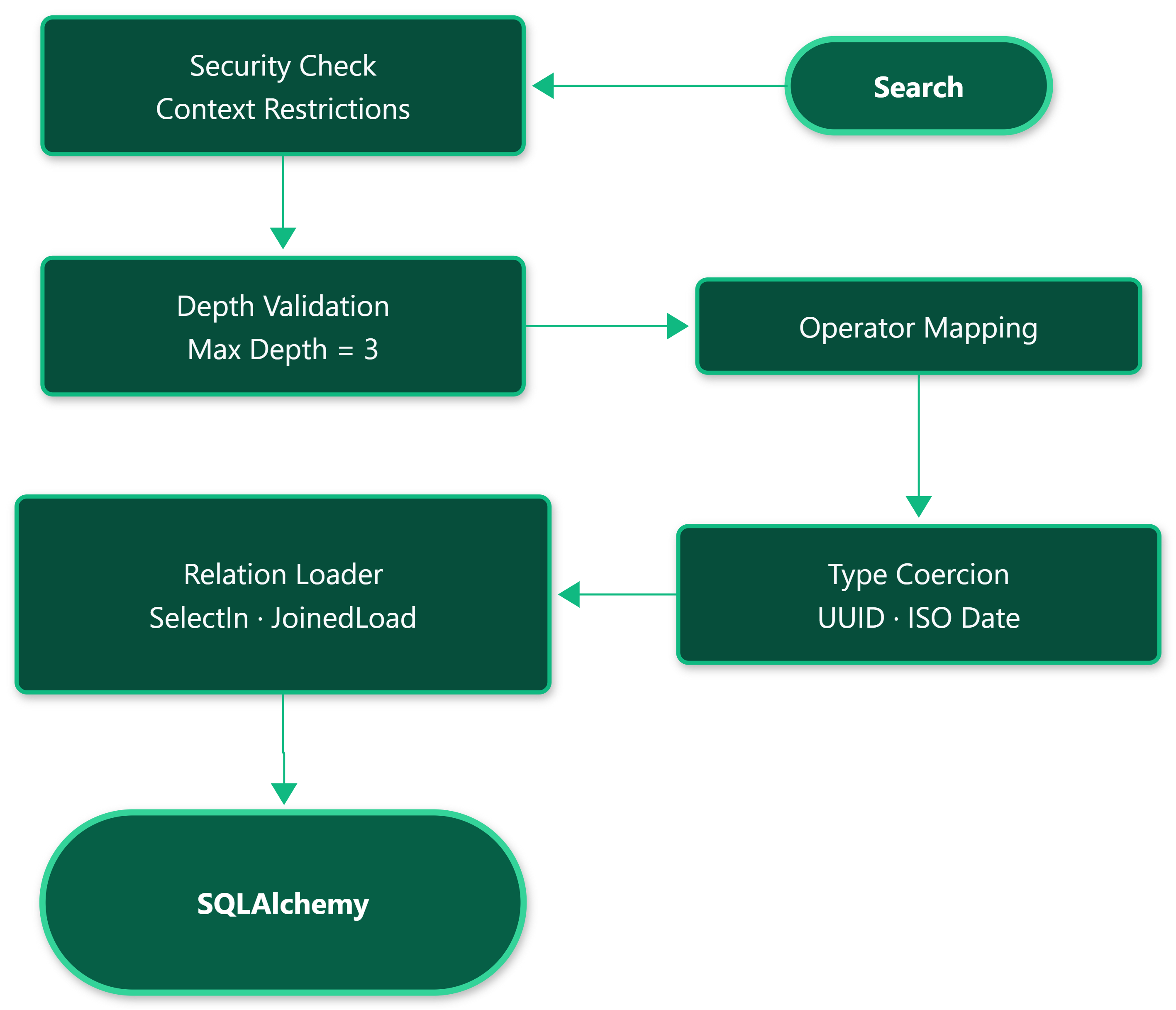
The SearchEngine validates and compiles the request through a strict security-first pipeline.
Boundaries & Integration
ZCore provides a dynamic bridge without locking you out of SQLAlchemy's native power.
- Select Object Return: The core engine method
build_base_query()returns a standard SQLAlchemySelectobject. You can still apply additional.where()clauses or.limit()before execution. - Custom Handlers: If a specific field requires complex custom logic (e.g., a full-text search vector), you can register a custom handler:
engine.register_handler("full_text", my_handler_func). - Bypass: If you only need simple primary key lookups, use the repository's
get()orget_by_ids()methods instead of the search engine to save processing overhead.
Under-the-Hood Spec
1. Recursive Depth Protection
To defend against "Recursive DoS" attacks, the SearchEngine enforces a max_depth limit (default: 3) [db/search.py]. If a client sends a JSON payload with more than 3 levels of nested or/and operators, the engine raises a ValidationError before any SQL is generated.
2. Intelligent Loader Strategy
The engine automatically chooses the most efficient SQLAlchemy loader [db/search.py]. It inspects the model relations:
- joinedload: Used for many-to-one or one-to-one relationships to minimize queries.
- selectinload: Used for one-to-many or many-to-many collections to avoid Cartesian products and "N+1" problems.
3. Safe Type Coercion
Since JSON sends everything as primitives (strings/numbers), the engine uses model inspection to coerce values [db/search.py]. It automatically detects if a target column is a uuid.UUID, date, or datetime and attempts to parse the incoming string using ISO 8601 standards before creating the comparison expression.
4. Wildcard Sanitization
For ilike operations, ZCore automatically escapes SQL-sensitive wildcards (%, _, \) [db/search.py]. This prevents clients from performing "blind" wildcard searches that could lead to full-table scans and performance degradation.
Security Isolation
The SearchEngine is strictly integrated with zcore.context. If a field dot-path (e.g., category.secret_code) is restricted in the active user context, any attempt to filter, sort, or include that field will result in a ForbiddenError.