Manage object lifecycles and resolve complex dependency graphs through thread-safe, constructor-based injection.
The Challenge
In standard FastAPI, dependencies are primarily resolved at the route level via Depends(). While powerful, this leads to:
1. Signature Bloat: Passing the same 5 dependencies through every function layer (Router -> Service -> Repository).
2. Lifecycle Confusion: Difficulty maintaining "Request-Scoped" objects (like a database session) consistently across multiple nested services.
3. Tight Coupling: Classes manually instantiating their dependencies, making units hard to mock during testing.
4. Circular References: No built-in protection against recursive dependency loops during instantiation.
The ZCore Elegance
ZCore provides a central IoCContainer that supports Singleton, Scoped, and Transient lifecycles. It uses constructor-based injection—meaning your services and repositories simply declare their needs in __init__. ZCore analyzes the signatures, resolves the graph, and detects circular dependencies before your code even executes.
from zcore import Inject

class PaymentService:
    # Dependencies are declared in the constructor
    def __init__(
        self,
        repo: PaymentRepository,
        notify: EmailService
    ):
        self.repo = repo
        self.notify = notify

# In the Router: Zero manual wiring
@router.post("/")
async def pay(service: PaymentService = Inject(PaymentService)):
    return await service.process()
# Dependencies must be manually passed through every layer
@router.post("/")
async def pay(
    db: AsyncSession = Depends(get_db),
    email_client: EmailClient = Depends(get_email_client)
):
    # Manual instantiation or repetitive Depends()
    repo = PaymentRepository(db)
    notify = EmailService(email_client)
    service = PaymentService(repo, notify)
    return await service.process()
Resolution Workflow
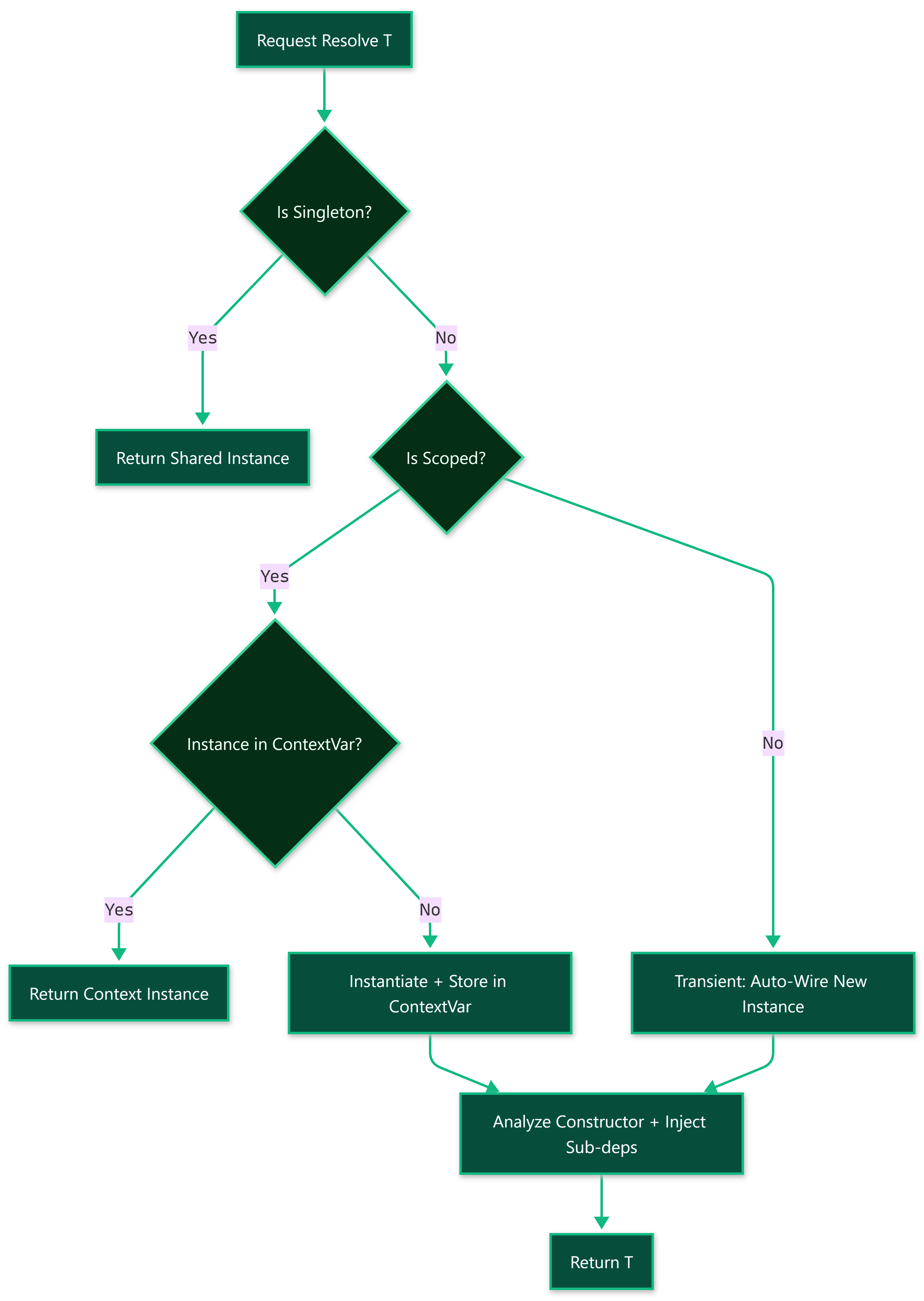
The IoC container follows a strict resolution path, checking lifecycles in order of persistence.
Boundaries & Integration
ZCore's DI system is a bridge between standard Python classes and the FastAPI ecosystem.
- FastAPI
DependsWrapper: TheInject()function is a lightweight wrapper. It returns a FastAPIDependsobject, ensuring full compatibility with FastAPI's native dependency tree and OpenAPI generation. - Web-Independent: The
container.resolve()method can be used in CLI tools, background workers, or unit tests without an active HTTP request. - Scoped Middleware: Request-scoped dependencies (like
AsyncSession) require theScopedDependencyMiddlewareto be active inmain.py. This middleware initializes and clears the context-local storage for every request.
Under-the-Hood Spec
1. High-Performance Signature Caching
ZCore avoids the runtime cost of Python reflection. The first time a class is resolved, the container uses inspect.signature and typing.get_type_hints to analyze its dependencies [kernel/di.py]. This metadata is stored in _dependency_signature_cache, allowing subsequent resolutions to skip the expensive introspection phase.
2. Circular Dependency Safeguard
During resolution, the container maintains a recursion _stack [kernel/di.py]. If the container attempts to resolve a class that is already present in the current resolution stack, it raises a CircularDependencyError with a clear trace (e.g., A -> B -> C -> A), preventing a stack overflow.
3. Annotated Metatype Resolution
The DI engine recognizes typing.Annotated during auto-wiring [kernel/di.py]. When a constructor parameter uses Annotated[AsyncSession, Depends(get_db)], the engine strips the Depends wrapper by extracting the first argument of the Annotated origin using get_args(annotation)[0]. This allows ZCore to correctly resolve parameters typed with Annotated aliases like SessionDep, maintaining full compatibility with FastAPI's native dependency patterns.
4. Forward Reference Resolution
The DI engine utilizes get_type_hints rather than raw annotations. This allows ZCore to correctly resolve string-based forward references or from __future__ import annotations blocks, which standard inspect logic often fails to parse correctly.
5. Context Isolation
Scoped instances are stored using contextvars [kernel/di.py]. This ensures that even in highly concurrent async environments, two different requests never share the same "Scoped" object, while still allowing all services within the same request to share the same instance (e.g., the same Database Transaction).
6. The get_db Dependency & SessionDep Alias
ZCore exposes a get_db async generator and a SessionDep type alias for seamless database session injection [db/setup.py]. get_db calls container.resolve(AsyncSession) through the IoC container, returning the request-scoped session managed by ScopedDependencyMiddleware. SessionDep is defined as Annotated[AsyncSession, Depends(get_db)], providing a clean, reusable type annotation:
from zcore.db import SessionDep

@router.get("/items")
async def list_items(db: SessionDep):
    result = await db.execute(select(Item))
    return result.scalars().all()
This eliminates per-endpoint Depends(get_db) boilerplate while keeping the injection point explicit and type-checkable.
Lifecycle Summary
- Singleton: Created once per application lifetime.
- Scoped: Created once per HTTP request; shared across all services in that request.
- Transient: A fresh instance is created every time it is requested.