Standardize your development without sacrificing the freedom of FastAPI. ZCore provides the architectural "chassis" for your application, coordinating dependencies, security context, and database transactions into a unified, predictable lifecycle.
The Challenge
While FastAPI is exceptional for building high-performance APIs, it provides no structural blueprint. As projects scale, developers often encounter: - Global Dependency Clutter: Difficulty managing different lifecycles (Singleton vs. Scoped) across modules. - Transactional Inconsistency: Scattered database commits leading to partial data writes. - Security Boilerplate: Manual field masking and permission checks repeated across dozens of routes. - Plugin Fragmentation: Hard-to-track initialization orders for background workers, caches, and database engines.
The ZCore Elegance
ZCore solves this by introducing a Plugin-based Kernel. Instead of manually wiring everything in a bloated main.py, you register domain-specific plugins. ZCore calculates the correct initialization order and manages the application lifespan automatically.
# Define a clean, isolated plugin for your domain
class PaymentPlugin(Plugin):
    name = "payments"
    dependencies = ["database", "auth"] # ZCore sorts these automatically

    def setup(self, app: FastAPI):
        app.include_router(payment_router)

    async def on_startup(self):
        await payment_gateway.connect()

# In your main.py: Simple, declarative registration
kernel = Kernel()
kernel.add_plugin(PaymentPlugin())
app = FastAPI(lifespan=kernel.lifespan)
kernel.setup(app)
# Standard FastAPI requires manual, sequential ordering in main.py
app = FastAPI()

@app.on_event("startup")
async def startup():
    # Manual ordering: If database isn't ready, payment fails.
    # This becomes a "main.py" file with 500+ lines in large projects.
    await init_db()
    await init_auth()
    await payment_gateway.connect()

app.include_router(payment_router)
app.include_router(auth_router)
# ... and 20 other routers
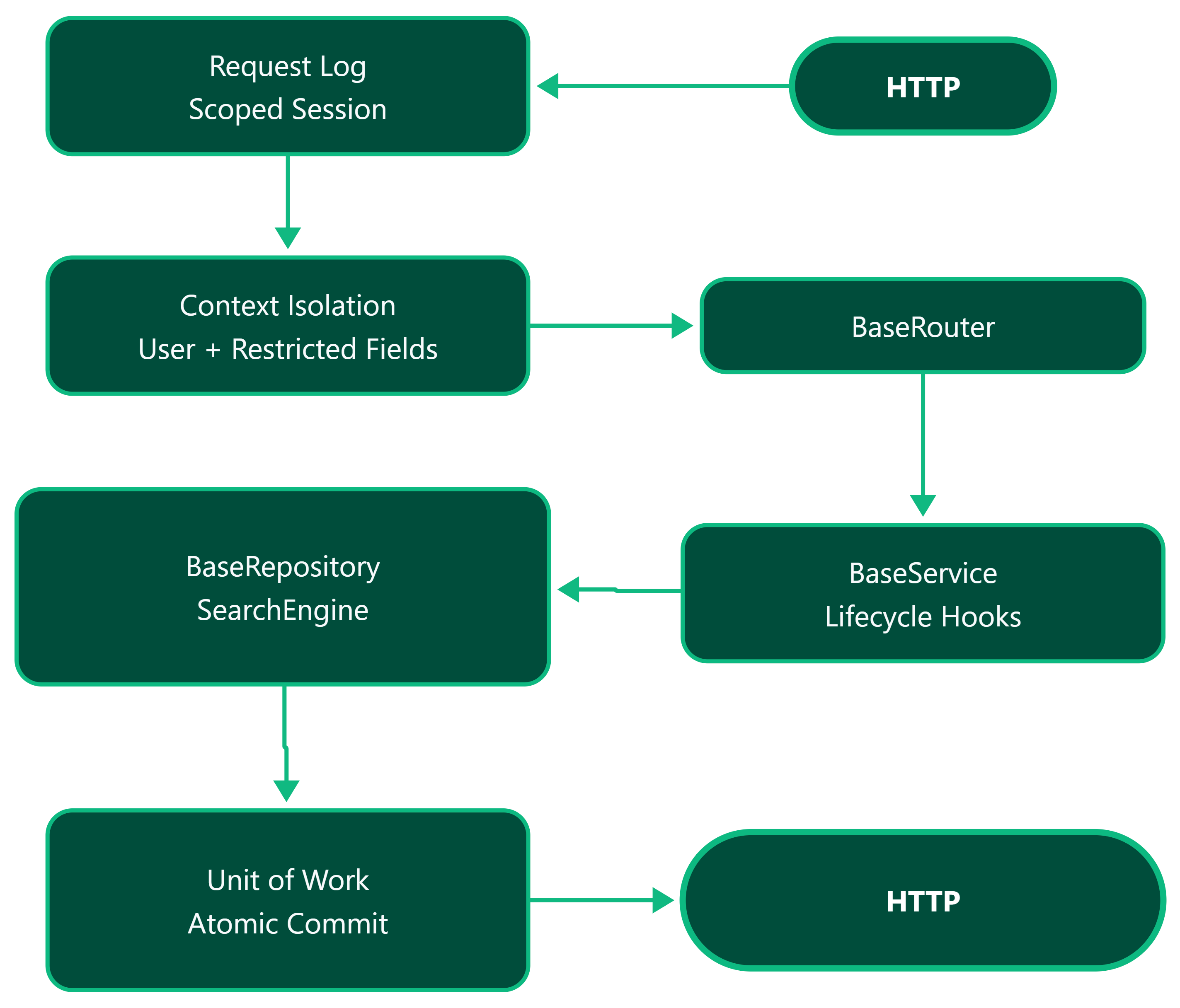
The Unified Request Journey
ZCore coordinates the request lifecycle through specialized middlewares and context managers, ensuring that every coroutine knows the current user and their data restrictions.
Boundaries & Integration
ZCore is designed as a complementary chassis. It does not hide FastAPI; it stabilizes it.
- Pydantic Compatibility:
Zchemainherits directly from Pydantic'sBaseModel. You can use standard Pydantic features (validators, computed fields) exactly as you always have. - Starlette Middlewares: ZCore middlewares are standard ASGI/Starlette implementations. You can mix them with any other third-party FastAPI middleware.
- Bypass Strategy: If you have a route that doesn't fit the
BaseRouterpattern, you can write a standard FastAPI@app.get("/")path function. You can still useInject()to retrieve services or repositories from the ZCore container within that function.
Under-the-Hood Spec
1. Topological Dependency Resolution
The Kernel uses graphlib.TopologicalSorter to analyze the dependencies attribute of every registered plugin. This builds a Directed Acyclic Graph (DAG), ensuring that if Plugin B depends on Plugin A, Plugin A's on_startup always completes before Plugin B begins.
2. High-Performance Reflection Cache
The Dependency Injection (DI) container utilizes a signature cache. During the first resolution of a class, ZCore uses the inspect module to analyze constructor type hints. This metadata is cached, allowing subsequent resolutions to skip reflection overhead entirely.
3. Contextual Isolation
ZCore utilizes Python's contextvars to maintain thread-safe and coroutine-safe state. The request_context manager ensures that current_user_id and restricted_fields are never leaked between concurrent requests, even in a high-concurrency async environment.