Orchestrate domain logic with transactional safety and granular execution hooks.
The Challenge
When business logic lives in the router (the "Fat Controller" anti-pattern), applications become impossible to maintain. Developers struggle with:
1. Leaky Abstractions: HTTP logic (headers, status codes) mixing with business rules (tax calculations, validation).
2. Transaction Fragility: Manually managing commit() and rollback() in every function. If one operation fails halfway, the database is left in an inconsistent state.
3. Hook Spaghetti: Difficulty triggering side effects (like sending an email or clearing a cache) consistently after a database write.
4. Redundant Validation: Re-writing existence checks and ownership validation for every endpoint.
The ZCore Elegance
The BaseService acts as a pure-Python orchestration layer. It wraps repository calls with a rich set of Lifecycle Hooks (pre_create, post_update, etc.) and a smart Safe Commit mechanism. This ensures that business rules are executed in the correct order and that transactions are only finalized when all steps succeed.
from zcore import BaseService, Inject
from .repositories import OrderRepository
from .models import Order

class OrderService(BaseService[Order, OrderCreate, OrderUpdate]):
    def __init__(self, repository: OrderRepository = Inject(OrderRepository)):
        super().__init__(model=Order, repository=repository)

    async def pre_create(self, schema: OrderCreate):
        # 1. Validation logic before DB hit
        if schema.amount <= 0:
            raise ValidationError("Invalid amount")

    async def post_create(self, model: Order):
        # 2. Trigger side effects after successful write
        await email_service.send_receipt(model.user_id)
# Logic scattered in the route handler
@app.post("/orders")
async def create_order(data: OrderCreate, db: AsyncSession = Depends(get_db)):
    # 1. Manual Validation
    if data.amount <= 0:
        raise HTTPException(400, "Invalid amount")

    # 2. Manual DB Logic
    new_order = Order(**data.model_dump())
    db.add(new_order)
    try:
        await db.commit()
    except Exception:
        await db.rollback()
        raise

    # 3. Manual Side Effect
    await email_service.send_receipt(new_order.user_id)
    return new_order
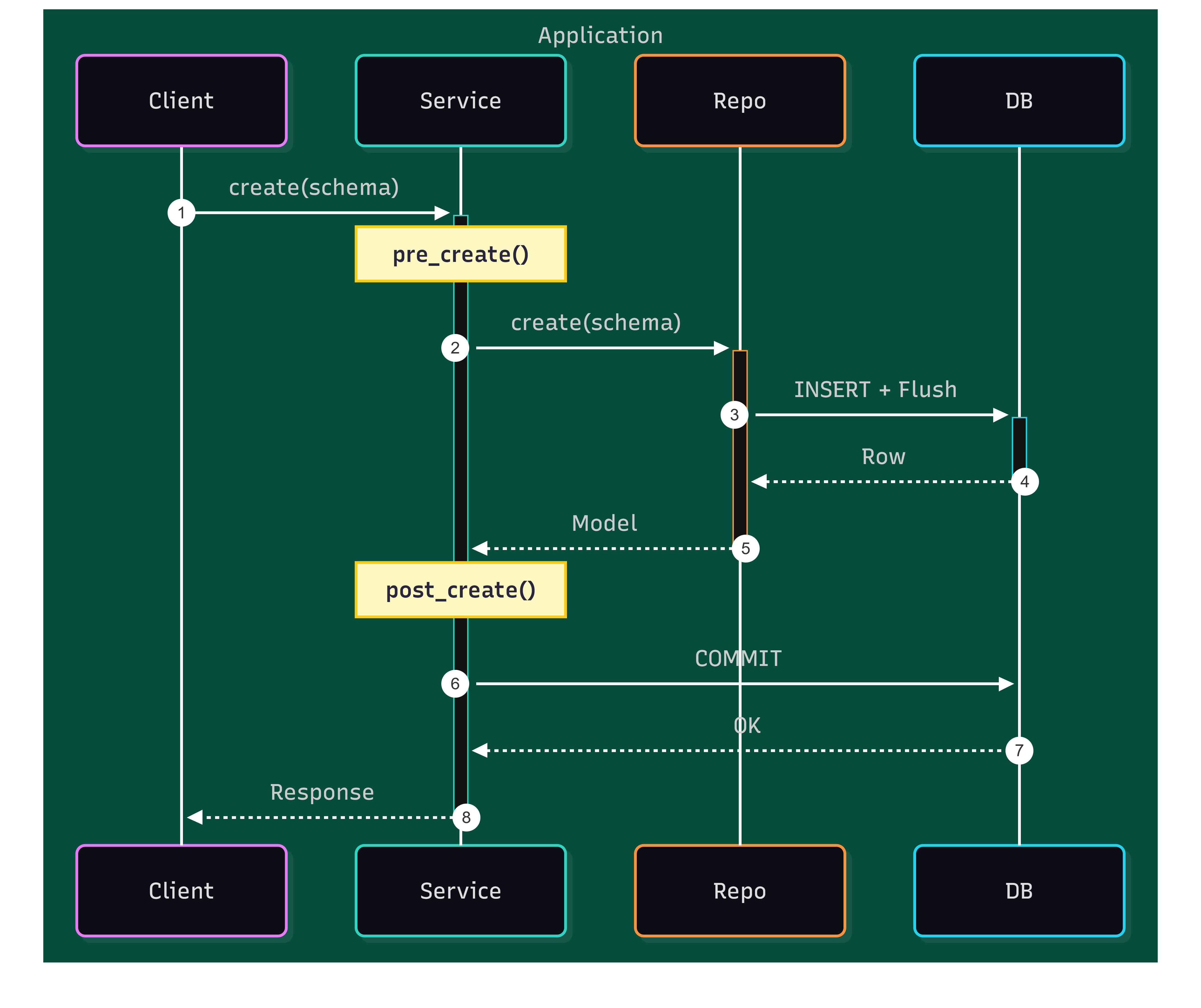
Lifecycle Execution Flow
ZCore services follow a strict execution sequence for every mutation. If any step (including a hook) raises an exception, the entire operation is aborted.
Boundaries & Integration
ZCore services are designed to be framework-agnostic business units.
- HTTP Independence: Services do not accept
Requestobjects or returnJSONResponse. They deal strictly with Pydantic schemas and SQLAlchemy models, making them easily testable in CLI scripts or background workers. - Dependency Injection: Use the
Inject()helper to pull in other services (e.g.,NotificationService) or repositories directly into the constructor. - Bypass: If you don't need the lifecycle hooks, you can call the core execution methods (e.g.,
on_create,on_update) directly, or bypass the service layer entirely by injecting the repository into your router.
Under-the-Hood Spec
1. The Safe Commit Protocol
The most critical feature of WriteServiceMixin is _safe_commit() [service/base.py]. Before committing, the service inspects the database session's internal metadata (session.info). If the key uow_managed is set to True, the service refrains from committing. This allows an outer UnitOfWork to group multiple service calls into a single atomic transaction without the services "breaking" the transaction boundary prematurely.
2. Post-Read Interceptors
Read operations (get, get_list) include post_get and post_get_multi hooks [service/base.py]. These are ideal for dynamic property calculation or permission-based filtering that happens after the data leaves the repository but before it reaches the router.
3. Automated Error Mapping
The service layer automatically translates missing database records into standardized EntityNotFound exceptions [service/base.py]. This ensures that your API consistently returns a 404 Not Found with a structured error message without you having to write manual if not result checks in every method.
4. Partial Patch Support
The update method intelligently handles the partial flag [service/base.py]. When partial=True, it instructs the repository to ignore None or unset values in the update schema, facilitating clean HTTP PATCH implementations.